Paint, Patterns and Places: Ossip Klarwein & Alvin Mavignier


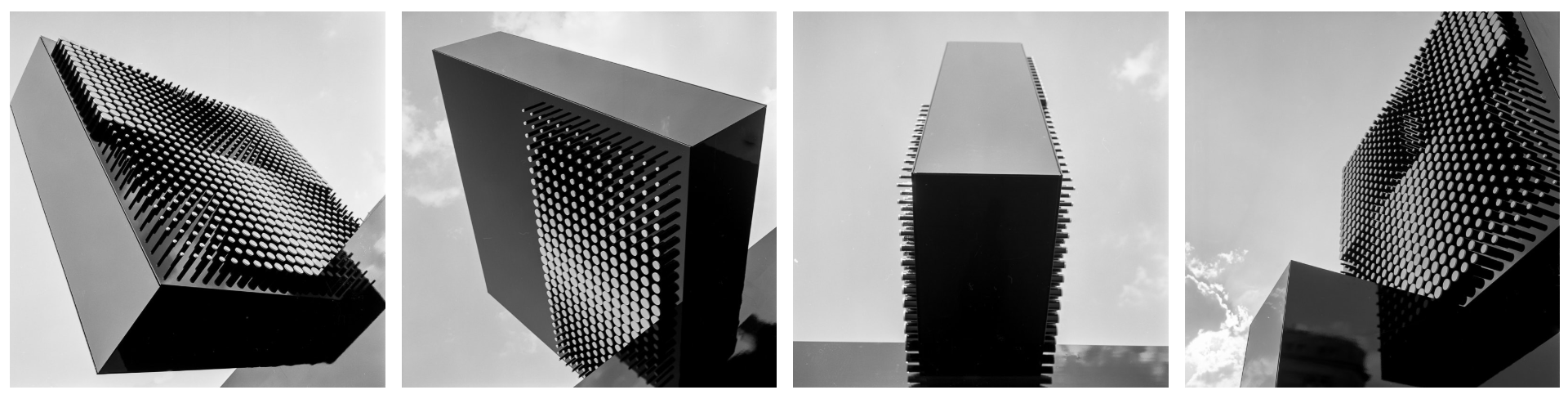
Almir Mavignier, convex, concave, convex, 1971 | photos Carlos Struwe 1975


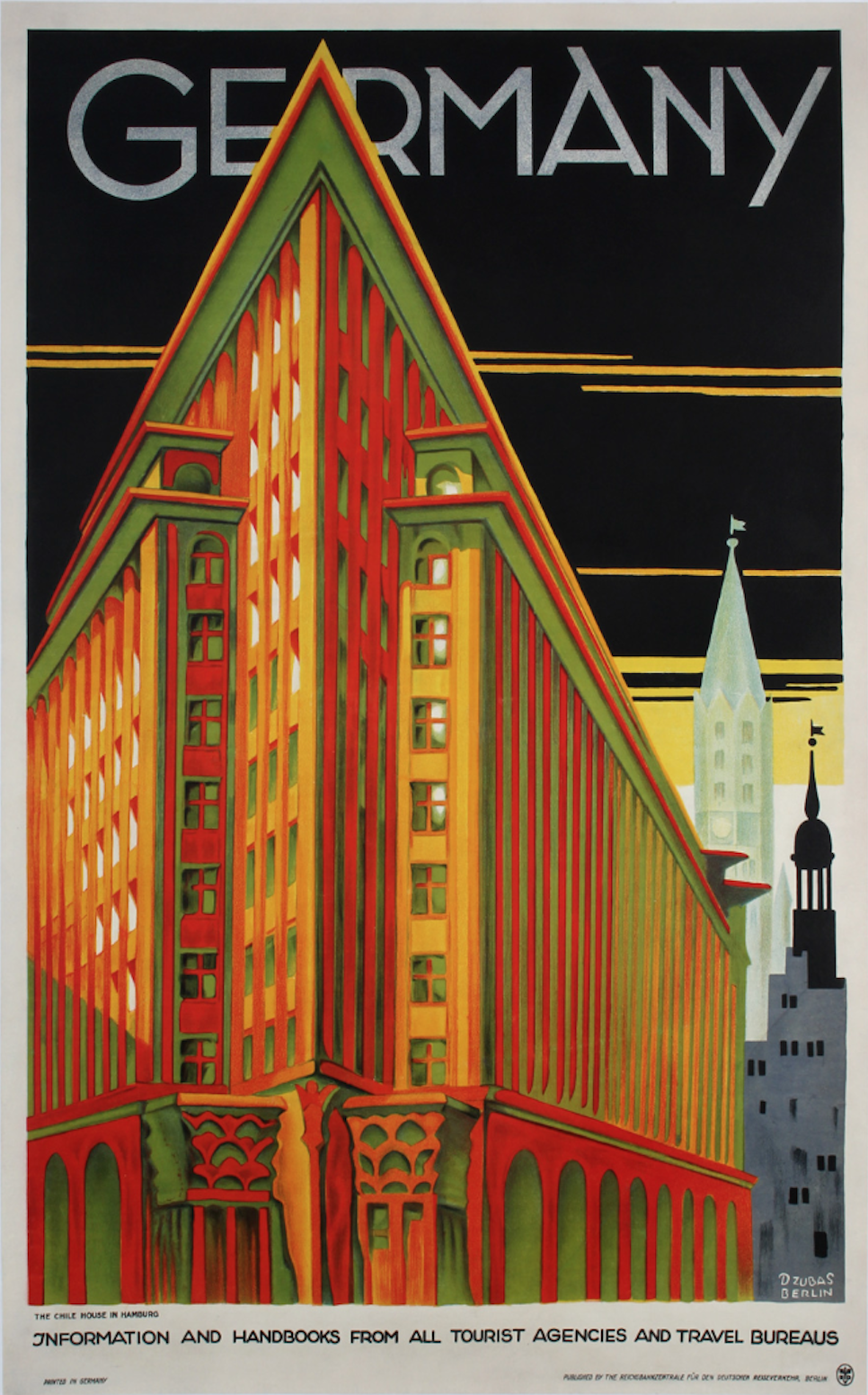
I’m sure you will know the Chilehaus – that ship‑like giant, built of brick, jutting out in Hamburg’s Kontorhaus district. It’s a landmark of Northern German Brick Expressionism, designed by Fritz Höger and completed in the early 1920s [see an image down below]. But little is known that this iconic landmark set the stage for another brilliant mind: Ossip Klarwein (1893–1970).

In 1927, Höger hired Klarwein as chief architect. Until 1933—a pivotal year in German history—Klarwein helped shape the look and ambition of Höger’s office. His influence reached beyond Hamburg, most famously with a Berlin church at Hohenzollernplatz, whose bold silhouette earned it the nickname “God’s power station.”

1935. Photo by Carl Dransfeld † 1941-11-09, Public domain, via Wikimedia Commons
Ossip Klarwein, Kirche Hohenzollernplatz, Berlin 1930-33 | photo by Carl Dransfeld, 1935 | public domain, via Wikimedia Commons

Ossip Klarwein was closely connected to Hamburg and the building styles of the North Sea region. When the Nazis took over in 1933, he was forced to leave for Haifa, Palestine. He first scrambled to gain a foothold, but by 1945, he was appointed to design key public buildings, thereby coining a Modernist style that would shape many later structures.

Many, only very recently excavated visual and written documents have been assembled to an exhibition of international collaboration: a collage of Klarwein’s life and work. Complemented by large-format pictures by the Israeli photographer Eli Singalovski (*1984). After its premiere in Berlin in October 2025, it is now showing at the Ernst Barlach Haus, as one of over forty contributions to The Jewish Cultural Heritage Days, 2025.

This, however, is only half of the “story” –

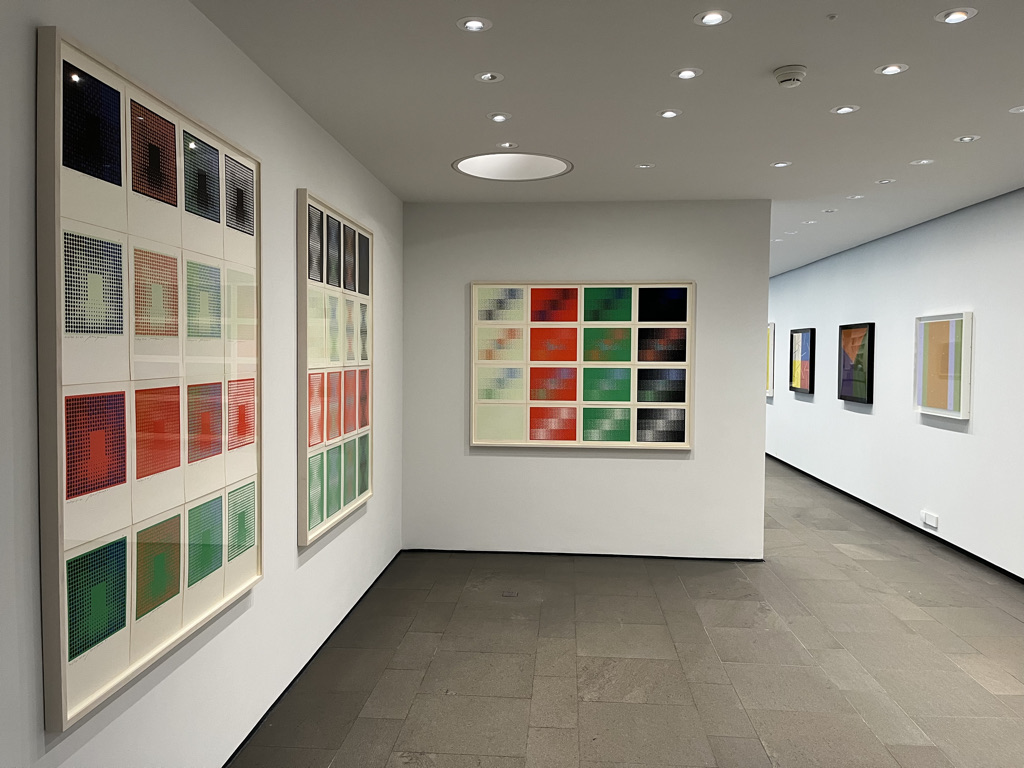
The Barlach Haus with its white, rather modest façade, does not immediately suggest that it can comfortably host two exhibitions at once – and yet it does. In the other half of the museum it feels like stepping into a very different universe: one of vibrating colour fields, serial structures and optical surprises. Here the atmosphere shifts towards Op Art – a movement many have heard of, but fewer could confidently explain, which is exactly what we will be exploring during the second half of our visit.

At the heart of this second “chapter” is Brazilian‑born artist Almir Mavignier (1925–2018), who had a deep and lasting connection to Hamburg. Mavignier is recognised as an important representative of Concrete Art and Op Art, who taught for 25 years as a professor at the HfbK, influencing generations of students. His artistic path began early in Brazil, where he worked simultaneously as painter, graphic artist and teacher.
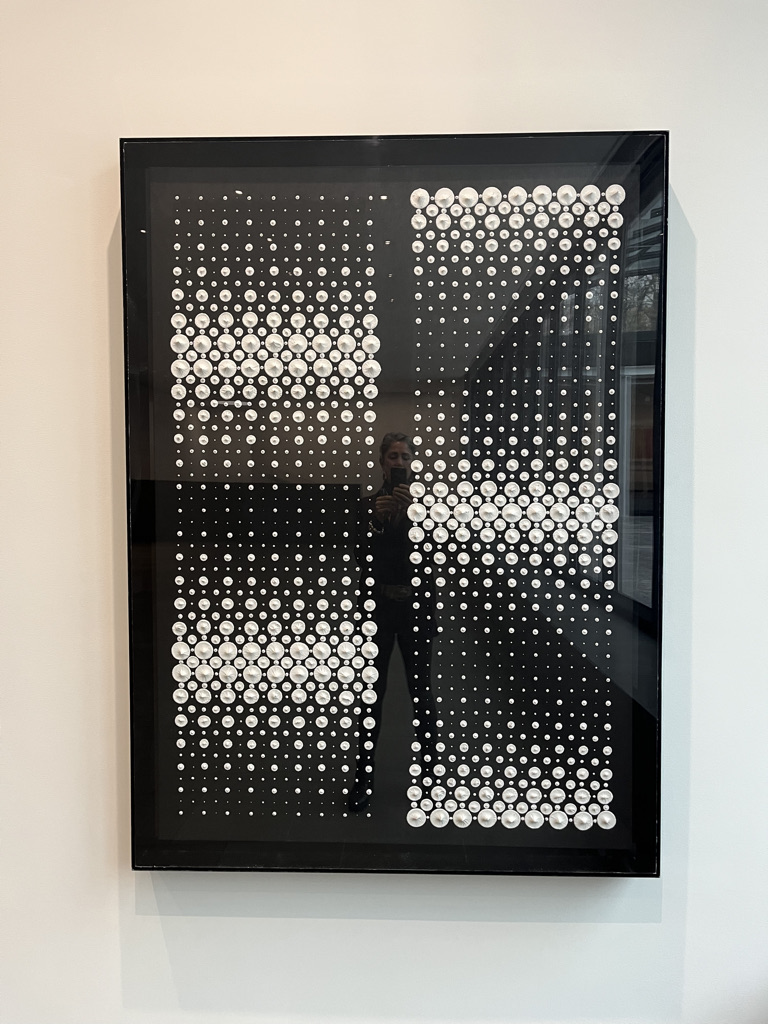
An especially formative period was his work leading an art studio in a psychiatric clinic, where he experienced first‑hand how powerful simple forms and colours can be. Mavignier’s international breakthrough came after he moved to Paris and later to Ulm, where close contact with artists and thinkers such as Max Bill and Josef Albers sharpened his interest in systematic colour experiments and serial structures.

Instead of telling stories with figures or landscapes, Op and Concrete Art work with perception itself: grids, dots, lines and pure color are arranged so precisely that your eyes begin to do the “moving” for you. Standing in front of these works, you may notice patterns that seem to shimmer, tilt or pulse, even though the canvas is perfectly still. The longer you look, the more your own vision becomes part of the artwork.

If you are in Hamburg, Germany then you may have even unknowingly walked past one of his few large outdoor sculptures titled convex concave and convex that was installed in 1971 at the Kirchenallee, Hamburg Hauptbahnhof. The complicated process of assembling the over six metres tall, black and white sculpture is documented on the official Mavignier website, run by his artist-son, Delmar Mavignier. It includes a full-length interview with the Almir Mavignier and shows many detailed, contemporary photographs by Carlos Struwe.

In the context of the Klarwein exhibition, Mavignier’s works add a rich counterpoint: while Klarwein builds with concrete and space, Mavignier builds with colour and perception – but both with the principle of organising spaces with repetitive patterns. Let’s explore these two remarkable modernists at Ernst Barlach Haus in Hamburg by booking tickets for my next tour here:

Book online

Novembersonne


Werner Scholz. A Forgotten Artist of the Weimarer Republic

Seated at my breakfast table, I had been looking out through large windows, across the heavy and sturdy roofs of the houses opposite, into the vast, always grey-tinged Northern German skies, pen in hand. It was hard to pinpoint my feelings, bedded in a deep-rooted sense of anguish. There was still so much grief and sadness, often disguised as anger or rage mixed with isolation and loneliness. I longed for warmth, rich, warm colours, golden hues – for a simple hug, an embrace from some source of warmth and care. The gothic light and the ever-impending sense of doom was gnawing at me.

Little did I expect, a few days later, to walk into an exhibition and be greeted by those very feelings from my diary entry in the form of a painting. But there I was, in a spacious, well-lit and elegant art museum, the Ernst Barlach Haus. From the entrance area, I could already see the picture, which was displayed as the first artwork of this newly installed show, from afar and I was immediately drawn towards it. I’m in a very inquisitive and highly susceptible mood. After all, this German artist, Werner Scholz (1898–1982) is being placed amongst other world-famous artists of his time such as Rudolf Schlichter, Georg Grosz, Karl Hubbuch or even Otto Dix – but hardly anyone has ever heard of him.

A quick search on the internet before my visit had only resulted in a handful of very rudimental information on him, like from one small past exhibition and auction prices that were nowhere near those of his contemporaries. Titled, Werner Scholz. Das Gewicht der Zeit (The Weight of Time) this exhibition shows paintings that were not destroyed when Scholz’ studio in Berlin was hit by a bomb in 1944. In 1937 the Nazis had banned him as a ‘degenerate’ artist from working and exhibiting. Scholz withdrew to Tirol in 1939.

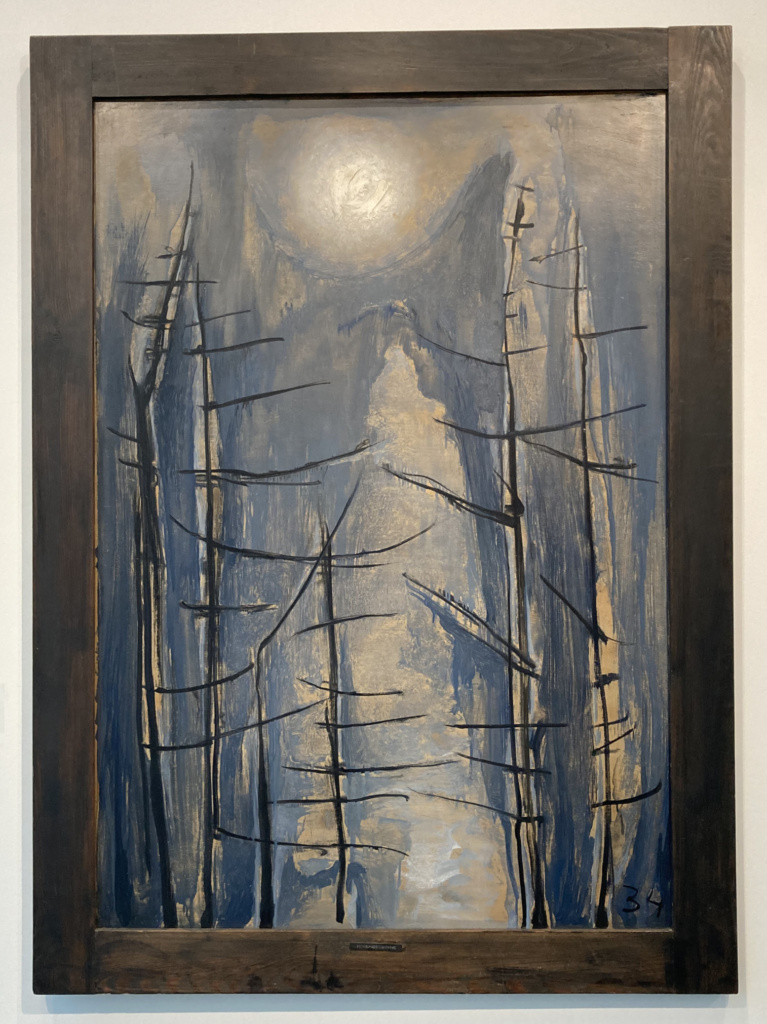
I step closer to gain a better look: It is quite a large piece in portrait format, which is unusual for a landscape painting. It is still in its original very simple, dark wooden frame, which bears a small plaque at the bottom with its title: Novembersonne (November sun). It merely depicts bare black trees and the sun. There is no depth in the picture, no foreground or middle ground, just broad, slightly erratic vertical washes of gloomy blueish-grey shades interspersed by some streaks of white, even leaving in parts, the painting’s ground visible, interrupted by stick-like trees that make me think of the German word Strichmännchen (small stick man). Its central motif, like the title indicates, is an impasto sun, executed in thick, round swirling brushstrokes; palpable and cold, its light, oily-white – foreboding of all the terrors that were yet to come?


November Blues..?

Not only did it so acutely reflect this “gothic” light, so pre-dominant in the North, but strangely enough, it also looked a bit like a highly stylised version of the very last photo I had taken with my iPhone and posted to Instagram: Huddled in a blanket at my desk, hugging a hot water bottle – I had had this urge to document this atmosphere, I needed someone to bear witness to this strange and stark cold sun, framed by the naked branches of two tall trees, glaring at me like the spotlight of an interrogation lamp, luminously but still only feebly, pushing itself with all its might through the dense, humid and nebulous sky. Only that my snapshot was from 2024, precisely 90 years later. But with its similarly gloomy notion could well be titled “February Sun”: The world was still recovering from the consequences of the COVID-19 pandemic and now, wars were raging in Ukraine, Gaza and Sudan causing disastrous humanitarian crises and consequences still to be feared.

Werner Scholz painted Novembersonne in 1934 – a year after the Nazis had forcefully seized power in Germany and whose dominant, aggressive and terrorising presence had been especially tangible since the 1920s in Munich and the metropolis Berlin. This is where Werner Scholz was born on October 23, 1898, to the architect Ehrenfried Scholz and the pianist Elisabeth Scholz, née Gollner – into an artistic, bourgeoise household, like one of his very early works, Wintergarten from 1919 shows. It was the second painting I walked over to, summarises. It depicts his father in an armchair, reading. Stylistically this early work shows all the prominent signs of a still-young artist experimenting with different late-impressionistic elements, trying to find his voice: There are some Matisse-like features, patterns and details, some flat, Gauguin’esque areas of colour with dark blue contour lines and some sun-dappled leaves à la Monet. It is the only painting in the exhibition executed on canvas.


The (Unexpected) Horrors of the First World War

In 1916, Scholz had begun studying art at the Hochschule der Bildenden Künste in Berlin, but then, in the following year, enlisted euphorically, like many other patriotic young men and women, in the army to fight in the First World War. His contemporaries included other artists: Max Ernst, Richard Dehmel, Otto Dix, Alfred Döblin, Ernst Ludwig Kirchner, Oskar Kokoschka, Wilhelm Lehmbruck, Ernst Toller and Georg Trakl were among those who volunteered for military service. The offspring of the middle and upper classes, in particular, yearned to show Germany’s “enemies” what they were made of. Under the misapprehension – not only in Germany – the war would be a short-armed conflict and that they would return home by Christmas.

The First World War was the first industrialised war in human history and the murderous power of new weapons had been underestimated: Machine guns, heavy artillery, and tanks. The result: trench warfare, material battles, and poison gas – a regional conflict turned into a four-year world war that claimed 17 million lives.

Thus, on his 19th birthday, Werner Scholz was seriously wounded in action in Northern France and lost his left forearm. After convalescence and the ending of the war, Scholz resumed his studies in Berlin in 1919. But thereupon, was no longer able to stretch a canvas over a frame with only one arm, so he used, from then on, hardboard. He also started to reduce his colour palette drastically and developed fairly quickly, over the course of less than ten years a unique and highly recognisable style.


Berlin’s Nollendorfplatz: Entertainment Hub and Stage for Nazi Terror

In 1920, after having resumed his studies and then graduating from art college, he rented a studio on the famous Nollendorfplatz, a large and busy square in the central Berlin district Schöneberg. For anyone who has ever visited Berlin or is familiar with other artists of the Weimar Republic and its culture, the name, colloquially also called Nolle or Nolli, will ring a bell.

Ernst Ludwig Kirchner. Nollendorfplatz, 1912

In the “roaring” 1920s, many artists congregated in the district. The era between the wars was explosive and was later dubbed, “Der Tanz auf dem Vulkan” after a 1938 film (Dance on the Volcano). The cinemas and clubs served as popular hangouts and sources of inspiration for artists, writers and musicians. One of the most famous clubs was the Eldorado, which was, like the Nollendorfplatz, immortalised in multiple artworks: There’s a watercolour by Otto Dix Eldorado (1927) depicting three “women” in a very vibrant setting drenched in red, purple and gold or Ernst Fritsch’s slightly more demure triptych, Erinnerung an Eldorado (1929–32).

The “objective view” of the Neue Sachlichkeit shows these flamboyant characters unhindered, like in Christian Schad’s portrait, Count St. Genois d’Anneaucourt (1927), which depicts a Hungarian count fallen from grace, a virile baroness and a notorious transvestite form a glacial ménage-à-trois on the right side of the painting, who was a well-known transsexual, and a regular at the club Eldorado. Writers, like the English memoirist, Christopher Isherwood, who lived just around the corner in an apartment at Nollendorfstrasse 17, and was part of the vibrant gay scene, found much inspiration for his works. His building was full of eccentrics who inspired his novels “The Last of Mr. Norris” and “Goodbye to Berlin” – and, most famously his Tony Award-winning Broadway musical ‘Cabaret’. 

Werner Scholz. Junge Frau (Young Woman), 1932. Pastel | photo by Frances Livings

Christian Schad’s portraits have been described as “highly stylized […] their subjects’ overlarge, expressionless eyes and static poses, [which] tend to glamorize but rarely to flatter the sitters, and the frequent note of ambiguous sexuality stops short of eroticism.”

As recognisable as Scholz’s figures are as characters of the Weimarer Republic, his figures are never sexually-charged, extravagant or flamboyant. He hints subtly at the period with fashionable accessories from the 1920s that many of his figures are depicted wearing: a woman with a blonde bob and finely pencilled eyebrows, plumed hats, fur coats, short dance dresses and children in uniforms, pigtails and striped socks, which contemporary film footage from Berlin in 1927 can attest to at the end of this post.


Isolated Marionettes with Angular, Wooden Movements

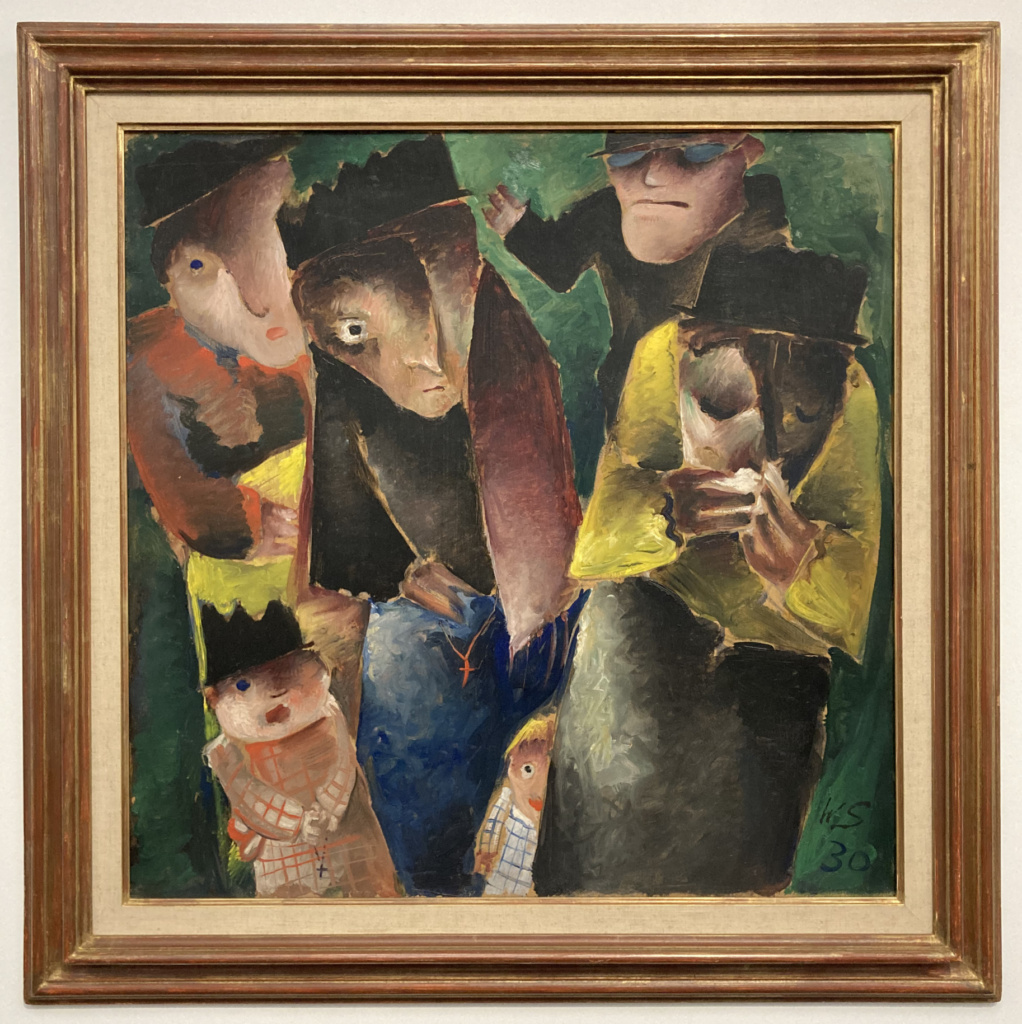
Werner Scholz. Widwen (Widows), 1931. Oil on hardboard | photo by Frances Livings

In Scholz’ early paintings from 1927 (the exhibition focusses solely on his works from 1927 to 1937) his figures are cartoon-like marionettes with stiff and angular, wooden movements. Influences from the Dada movement are apparent. Some have animal-like heads, some have puppet faces, are beady-eyed or even one-eyed, and many have pursed lips. He may add an individual prop, an occasional park bench or a café table. But none of them are especially inviting. They add moreover, like his non-specified backgrounds, to a great sense of isolation.

Specific motifs like desperation, grief, isolation and the imbalance of power start to become apparent in his early works from around 1927 and culminate in the late 1930s.

These details appear almost bizarre in contrast to the anguish of the actual figures – mostly expressed in the faces and postures of increasingly block-like figures. In the late 1920s and early 30s, Scholz turned to these more picture-filling and compact figures compiled of trapezoids, squares and other angular shapes. These paintings’ backgrounds become very ominous and vague, staging the bizarre and whimsical theatre performances of his figures in barely defined, monochromatic pictorial spaces.

Although the area around Nollendorfplatz was a flamboyant entertainment hub, it was where, on the other side of the coin, its residents and frequent visitors witnessed the so-called “Terroraktionen” of the up-and-rising National socialists. Even before the Nazis seized power in 1933, Berlin, like Munich, was a fierce political arena and on numerous occasions, the SA provoked violent street battles, in which its members tried to shatter its opponents: members of the Socialist Workers’ Party. Many other insidious tactics were utilised to cause uproar and panic in public spaces, like on Friday, December 5, 1930, at a movie première:

Also located on Nollendorfplatz, opposite the other large cinema UFA-Palast, was the Mozartsaal cinema, built in 1905/6, and now called Metropolis. That said Friday in 1930, members of the SA released white mice into the audience. Screaming women caused the film to be interrupted while the SA men roared with laughter. Goebbels himself was sitting in the audience. Two days before the “event”, on December 3, 1930, he had briefly noted in his diary:

On Friday, we’ll be attending the film “Im Westen nichts Neues” (All Quiet on the Western Front) – to teach those eunuchs some manners. I’m looking forward to it.

– Joseph Goebbels (NS-Propaganda Minister), 1930

The film was based on the novel by Erich Maria Remarque, a German veteran of World War I, and first published in November and December 1928 in the German newspaper Vossische Zeitung, a nationally known Berlin newspaper that represented the interests of the liberal middle class. In late January 1929, it was then published in book form, which sold 2.5 million copies in 22 languages in its first 18 months in print. It describes the German soldiers’ extreme physical and mental trauma during the war as well as the detachment from civilian life felt by many upon returning home from the war.

As an intuitive and sensitive observer, like many artists, Scholz was not only a witness of these terrorising propaganda activities but was well aware of the dangers that were looming on the horizon, especially for the already impoverished working-class population and noted himself, only a month later, on Saturday, January 17, 1931, in his journal:

Yes, it is high time to oppose the furious destruction of culture by the Nazis… The atrocities that the fascists are already able to commit legally must, in their irresponsibility, be pointed out to the entire general public. And … hammer into people’s brains again and again what will happen when this dangerous faction gains power.

– Werner Scholz, 1931

On May 10, 1933, at the initiative of Goebbels, Remarque’s writing was publicly declared as “unpatriotic” and banned in Germany. Copies were removed from all libraries and restricted from being sold or published anywhere in the country.

But not only the portrayal of these harrowing experiences in books and movies but the scarred and injured participants themselves were constant reminders, especially the expansion-hungry National socialists (embedded most obviously in the term the term “Third Reich”) were eager to negate. In the years following the First World War, men who had obvious and often most debilitating war wounds found themselves shunned by a society that no longer wished for visual reminders of the conflict. But artists, with a mixture of sometimes even cruel realism, expressiveness and empathy, such as Scholz, like Dix or Grosz, turned towards them.

“Brutality! Clarity that hurts! There’s enough music to fall asleep to! … Paint as fast as you can! … capture time as it races by…”

– George Grosz


Werner Scholz’s Protagonists: Those Left Behind

Werner Scholz. Trauernde (Mourners), 1930.

Many of Scholz’s contemporaries captured the decadence and hedonism of the Weimar Republic. Scholz’s work however, reflected the profound suffering and disillusionment of the era. After the horrors of his own war-experiences he turned pacifist and communist and devoted himself to the petty bourgeois, the underworld and the Berlin demimonde: People in mourning, the destitute, those fleeing and those left behind are his protagonists – dignified figures with a haunting presence*. These are the very qualities that the German art critic Kurt Kusenberg (1904–1983) also recognised in Scholz’s figurative works of that period, writing in 1932:

Scholz is essential because he (…) addresses the issues of our time and takes formal risks and presents issues of our time that concern us all.   

– Kurt Kusenberg (art critic), 1932

‌This sensitivity to the social and political climate around him was evident not only in Werner Scholz’ portrayal of human figures but also in his landscapes, like “Novembersonne,” which evoked the very same palpable sense of melancholy and foreboding. His art became a mirror of the collective angst and turmoil experienced by those who lived through the tumultuous interwar period. “Novembersonne” was a reminder, how art has the power to transcend time and evoke emotions that are universally human. The painting’s stark, almost oppressive atmosphere, with its dark, bare trees and a sun that barely manages to pierce the gloom, seemed to resonate deeply with the current state of the world. It was a reminder that while the contexts may change, the fundamental human experiences of grief, fear, and longing for connection remain constant. Scholz had the courage to put his finger on the wounds, to express these feelings, which was exactly what I was facing…

* * *


“Das Gewicht der Zeit”, the exquisite exhibition showing paintings by Werner Scholz, closed in June 2024. But if you are interested in my art tours then stay informed by subscribing to my email list [see above] or check out these dates and buy tickets here:

Book online


_______________________________________________

*Karsten Müller, Exhibition catalogue: Werner Scholz. 2024, p. 62

Uwe Klußmann. 2012. “Conquering the Capital: The Ruthless Rise of the Nazis in Berlin.” Spiegel.de. DER SPIEGEL. November 29, 2012.

Christian Schad. 1997. “URBANE DECADENT.” The New Yorker. The New Yorker. September 22, 1997.

Livings in Los Angeles – Murals and Mug Shots. Thoughts on the Artist Mike Kelley


Art saved my life. Art was the place that made me want to educate myself. When I became an artist, it was where the most interesting thinkers were.

—Mike Kelley

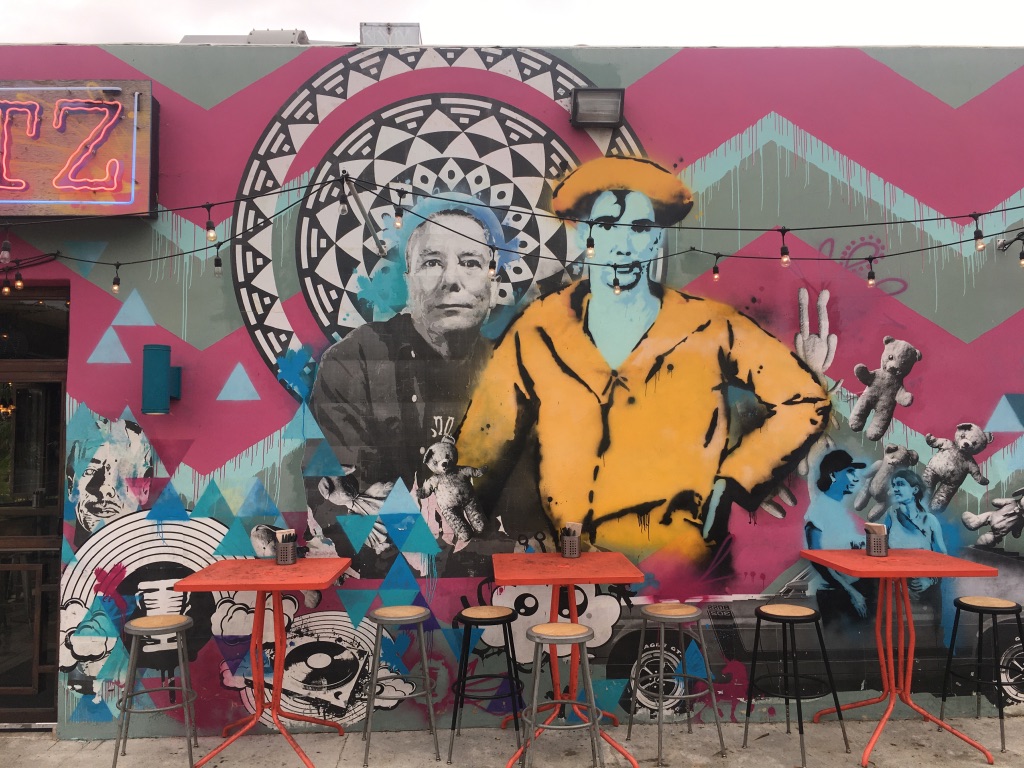
I seem to encounter certain artists’ works at sometimes random but also symbolic moments, like that of the contemporary American artist Mike Kelley. This afternoon I was strolling down Hillhurst Avenue in Los Feliz, and virtually bumped into a large mural depicting him. I immediately recognized his face and stood there for a couple of moments to take in the large double portrait, the zig-zag patterns, the black and white areole, bright colours, and flying teddy bears. I thought back to when I had first seen his work, which hadn’t been in L.A. It was years ago, on one of my outings to the Galerie der Gegenwart (gallery of contemporary art) in Hamburg, Germany.

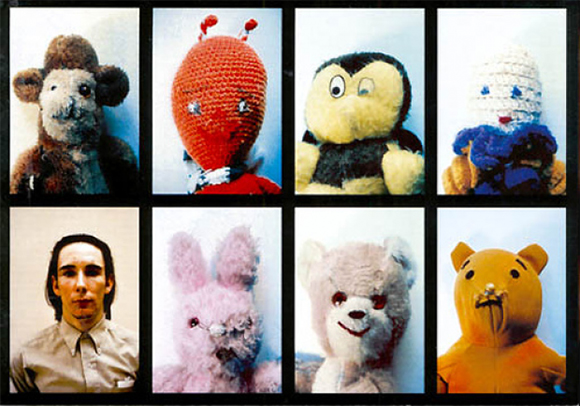
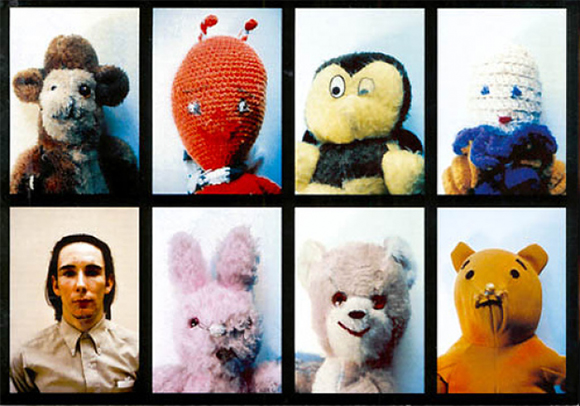
I had leisurely walked into one of the large gallery spaces and found myself transfixed by eight very unusual portrait photographs. Individually depicted were seven cuddly toys. Their stitched-on fabric or glass button eyes, some lopsided or missing, were staring at me with such resolve as if most desperately wanting to capture my attention. The eighth photograph is of a stern-looking young man with slicked back black hair, who I assumed, is the artist himself. The portraits are all displayed in a very simple frame and hung as a group in two rows of four. Despite the cool ambiance of an art gallery, and the innocence of the objects, they look like mug shots.

But wait, mug shots of an adult and children’s toys?

That was in the mid-nineties. I was a junior student of art history and discovered Mike Kelley’s artwork for the first time. It had immediately clicked. I didn’t know anything about his background, but I couldn’t help thinking about these strange mug shots from time to time. Maybe because they had also already found their way into music culture after Kelley created the artwork for Sonic Youth’s 1992 album Dirty, using Ant-Man’s “portrait” on the album cover.

Kelley was very connected to the LA art scene, which saw, starting in the 1990’s a very palpable period of growth and resurgence. He had initially studied under teachers like John Baldessari and Laurie Anderson at CalArts, where he earned a Master of Fine Arts. In addition to being a renowned visual artist, Kelley was also a musician, and before going to CalArts, a founding member of the proto-punk Detroit band Destroy All Monsters, who earned a cult following with their experimental performance art. Writing in The New York Times, in 2012, Holland Cotter described the artist as “one of the most influential American artists of the past quarter century and a pungent commentator on American class, popular culture and youthful rebellion.”

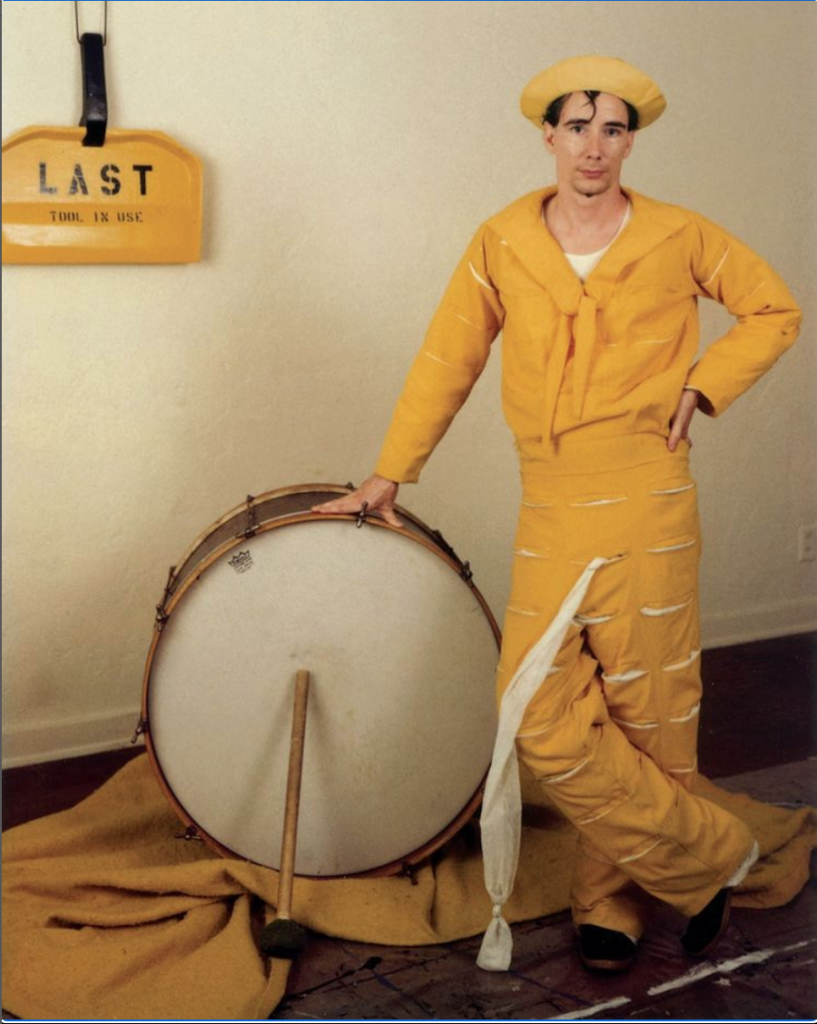
The following photograph must have served as a template for the mural above. It depicts Mike Kelley as The Banana Man: Written in 1981 and shot in 1982 while Kelley was teaching a performance/installation class at the Minneapolis College of Art and Design,1 The Banana Man was his first completed video work.

"Portrait


Stuffed Toys, Wax Candles, Afghans and Dried Corn

I had my second very intense encounter with Kelley almost two decades later. I had been living in Los Angeles for about six years and on one fairly uneventful, sunny morning, I was flicking through the L.A. Times when I read, that he had committed suicide. I was shocked in the way I often am when I’ve been assuming that life just flows along, that others will somehow always be around. He was only 57 and had by then established himself as an internationally renowned artist.

I dug a little deeper online, and read in further articles that only around four hours after confirmation of his death, an unofficial, makeshift memorial had started to appear in an abandoned carport at the top of Tipton Way, a few blocks from Kelley’s home in the Farley Building in Highland Park. Built from stuffed toys, wax candles, Afghans, and dried corn, mourners began replicating Kelley’s More Love Hours and Wages of Sin. These were two paired installations he had exhibited in The Whitney’s 1989 Biennial. I also learned that The Mike Kelley Foundation was organizing a memorial that was to be held at his studio in Eagle Rock/Highland Park on February 25, 2012.

I spontaneously decided to go. So on one of these for Los Angeles, typical mild February evenings, I drove through dimly lit streets to Kelley’s former residence. I parked on a side street lined with old gnarly oak trees, spiked with well-kept 19th-century craftsman bungalows, typical for South Pasadena. Like many pockets of Los Angeles, it felt very insular and isolating. I walked up to the main road towards the building in which the memorial was taking place. Its concrete steps led up to a very triste-looking entrance where a handful of people stood, collectively nodding as if to acknowledge my arrival. I felt a slight wave of guilt wash over me for being curious in a weirdly voyeuristic way. I had never met this man and yet I was showing up at a memorial – like a grief tourist? But I was curious. Who was this artist really? What was his provocative art really about?

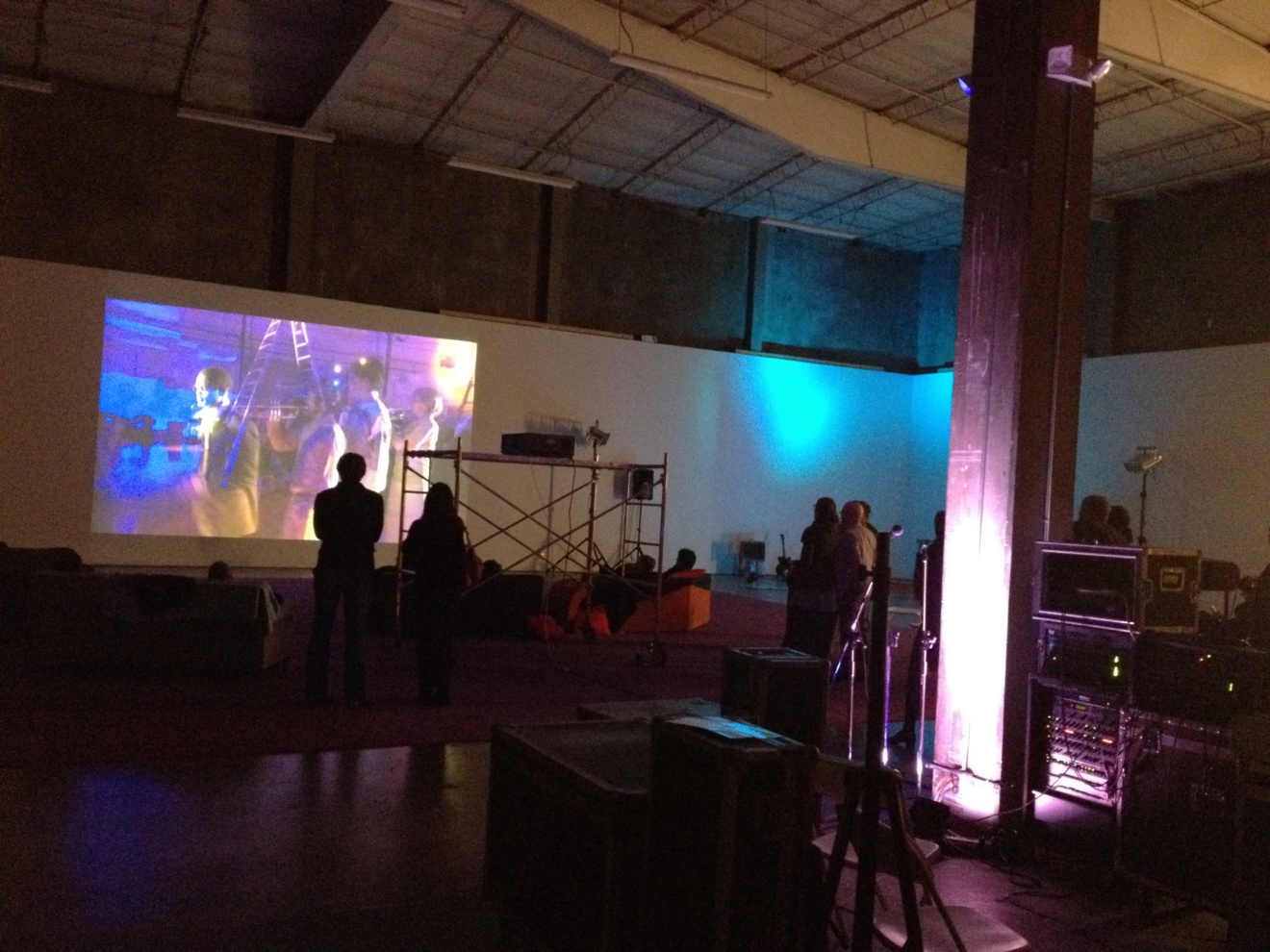
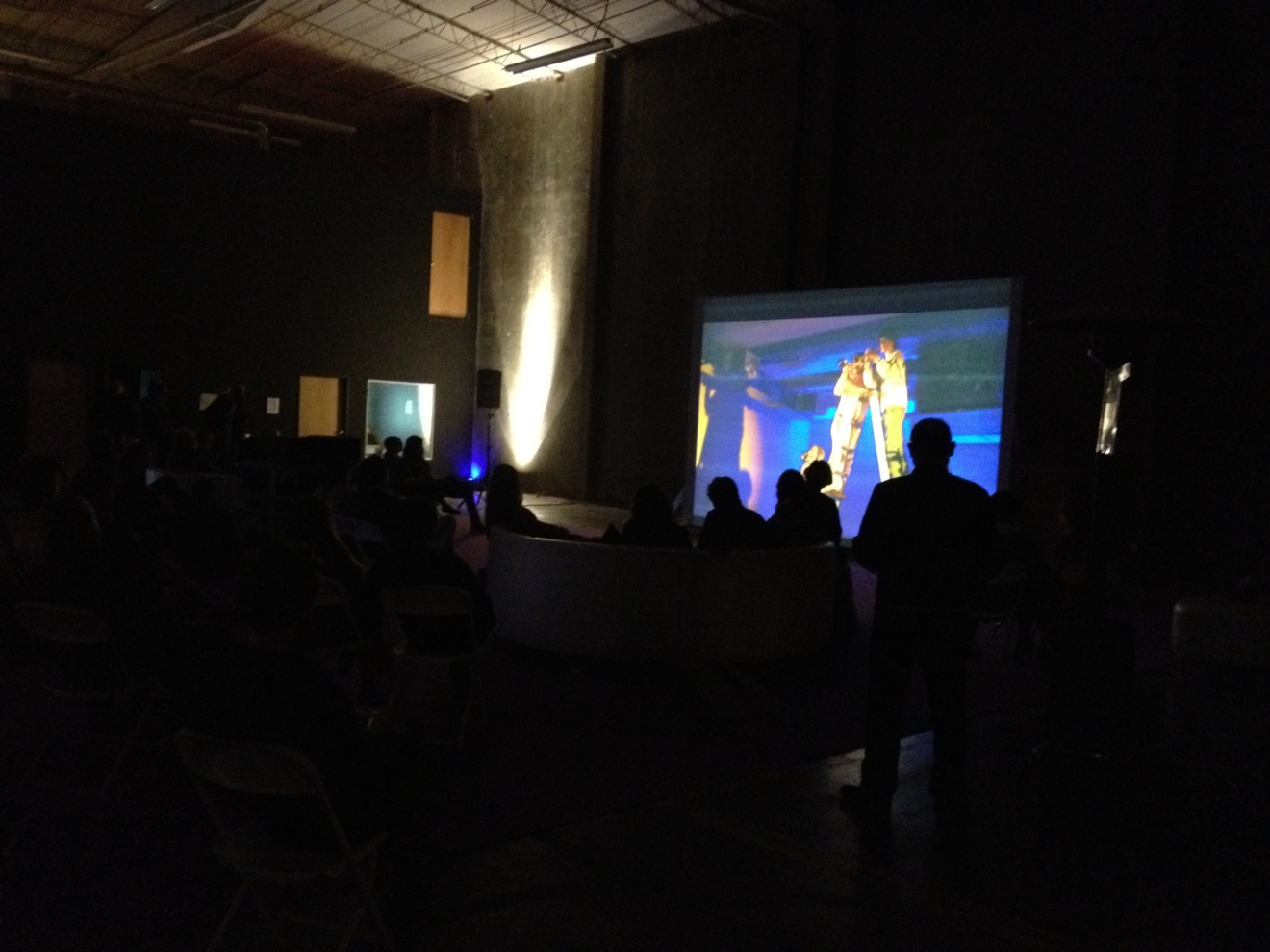
Like approximately another 100 people, I wandered around through this vast space, which had been, only days prior to his death, his studio. Plastic cup in hand, filled with cheap red wine, exploring a maze of small administrative-looking side-rooms, watching sometimes only for a few minutes films Kelley had created. The main space, his studio, where more art installations were displayed and further screenings took place, reminded me of a large airplane hangar [see more pictures below]. It was a solemn and strange event but I was glad to be able to participate in something…


Ant-Man, Teddy, Rabbit and – Mike Kelley…

Two years after his death, in 2014, the largest ever retrospective of Kelley’s work was shown at L.A.’s Geffen Contemporary, part of the Museum of Contemporary Art (Moca). An extensive catalog on Kelley was also published by Prestel. I was able to take a closer look at much more of his impressive oeuvre, including the Ant-Man, Teddy, and Rabbit ensemble, which was also on display.

What really struck me this time was the way they are sitting there: stiff and unhappy-looking, tatty creatures propped up to have their photograph taken. Their fur coat or croquet suit is dirty, worn, and faded, limbs are limp, and they sport a blank stare, exposed by the bright flash of a camera. They seem like visual proof, tokens of having been thrown, kicked, punched, spat, cried, and vomited upon – so ultimately the epitome of abuse and trauma. But were Ant-Man, Teddy and Rabbit really just physical witnesses to something horrible that was inflicted upon them? It is apparent that they are more there to tell a more complicated story.
Because on the other hand, these individual portraits still appeared to me like a collection of mug shots: seemingly innocent cuddly toys depicted as perpetrators on the stand in an almost accusatory manner. From that perspective they seemed to suddenly stand for shame and guilt – but how could stuffed animals be guilty of anything? Their images are physically enclosed, separate from each other, and kept in tyrannical order by a strict, linear picture frame – did they stand for something that was kept secret within the walls of a children’s nursery? But why were they augmented or maybe even contrasted by a further mug shot: one of a grim-looking male adult? Was he depicted as the abuser, with dark circles under his eyes, in a buttoned-up beige dress shirt? Or a prison guard?


That’s exactly what made Mike Kelley’s artwork so memorable, all of these questions and discrepancies…

There was more artwork on display in the exhibition including soft toys and I realized, how tempting it was to read soft toys as relics of an innocent and happy childhood. Moreover, to view in general, in society, nurseries as safe spaces. Childhoods are happy and parents loving – or not? But this is the very reason why so many moral conflicts occur when these ideas are challenged: Any notion that disrupts these stereotypes and clichés is easier being denied, which is why at that point in my life, just intuitively, I found his work compelling and courageous. Ultimately, for the very reason, parental abuse is so crazy-making.

Looking at his body of work, one may interpret his works of art, like those described above, as a result of trauma, translated into the many often disturbing, but clever images he produced. But this wasn’t what I was interested in asking. I didn’t need to know whether this ensemble of tatty, abused-looking creatures gave the observer biographical information about the artist. Nor was I really interested in speculating about why precisely he killed himself. The topics were evident. That was enough.

Standing there this afternoon, on a hot afternoon in September 2022, taking pictures of the mural, I realized that since his death in 2012, a whole decade had gone by. The mural also made it apparent that an artist (I have yet to find out who it is) revered Kelley enough to create a large double portrait on a prominent street corner. But also, that not only Kelley was deeply ingrained in the city’s cultural fabric but I was too. I had memories, whether of a painful or a joyful nature, which connected me socially, geographically, and emotionally to this schizophrenic city.

I suddenly realized why I had felt so compelled to attend his make-shift memorial in 2012.

I had felt on that strange, dimly-lit evening of his impromptu memorial that he deserved my tribute because I admired his courage to touch upon subjects that are still – decades later – socially somewhat taboo and sadly, therefore, for many unresolved. As children, we rarely have an ally when being abused or mistreated, ignored, or neglected by a parent. Moreover, until we heal we only too often put ourselves on the stand and take mug shots of ourselves – since, for any child, the reality of having an abusive parent is too painful and can threaten basic survival needs. Mike Kelley epitomized these complicated and highly problematic emotions.

Scenes of Mike Kelley's Studio during memorial 2012

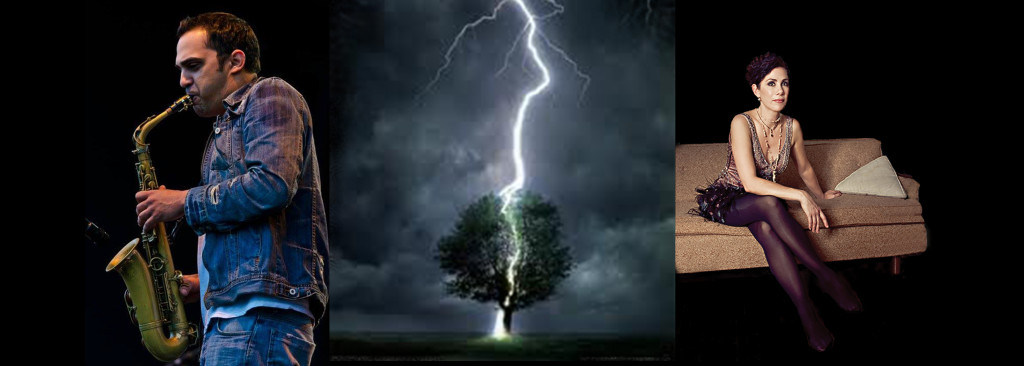
Saxophonist Zane Musa Songs of the Soul Frances Livings Poet

Songs of the Soul ~ In Memory of Zane Musa


Zane Musa – the first time I saw him play saxophone was at a small, hole-in-the-wall jazz joint. It was the summer of 2005. I was on one of my first visits to Los Angeles from Germany, where the guitarist Greg Porée and I had met. We had been working together at a small theatre in Hamburg. Drink in hand, we sat down, shortly before the show was to begin. So here we were on a date at this – dump.  Secretly, I was thinking very dismissively,

“What is all of this? This is not a proper city! This is not a proper jazz club! L.A. is so ugly. It’s like a barren, flat and never ending suburb, punctuated every now and then by strip malls, like this thing here…”

But Greg swore these were really good players.

Whenever I had attended jazz concerts in Germany, the venues in which they were held were mostly historical theatres, lovely outdoor venues, like parks or on the waterfront. They always mirrored the anticipated beauty and specialness of the music. I therefore simply didn’t expect much walking into that dumpy little bar.

The small stage was only dimly lit. My eyes fell on this lanky, dark-haired, good-looking guy. I watched him as he just stood there, swaying almost unnoticeably to the venue’s background music – or to his own? His horn hung around his neck and cupping its bow, he lightly cradled his instrument. He seemed oddly detached and lost, clutching his saxophone.


The Saxophone in Jazz

The saxophone is obviously a staple in jazz music. I personally, however, associated the sound of this instrument with the sickly sweet and whiney notes of players like Kenny G. dwindling annoyingly from the supermarket and car radios. Having gained most of my listening experiences in the eighties and the nineties, a saxophone was the epitome of elevator jazz. But then the band started and this disinterested seeming guy started hitting his first notes; delving deeper and deeper into the music, spiraling into almost delirious solos – my jaw hit the floor. Zane Musa was the most brilliant, moving saxophonist I had ever heard live.

BANNER_Songs-of-the-Soul-Zane-Musa-saxophone-death

After the performance, on the way out, I grabbed some of these square, flimsy paper napkins from the bar, and in the car I just dotted down every thought, rushing through my head. In the following weeks, the poem Songs of the Soul evolved. I only told my husband that Zane Musa inspired the piece. Nobody else. I was somewhat embarrassed by the impact he had made on me –

I had a musical crush on him.

Once the poem was completed, I felt as if I needed to deepen its intensity. I had only just started a new project recording some of my poetry. Nervously I contemplated asking Zane to play on “his” poem. I wouldn’t tell him of course that it was about him. My goal was to recite the piece and ask him to respond in a duet, as if he was at a live jazz gig, improvising on the spot. I wanted to capture a complete performance –also of my reading– rather than the usual studio procedure of assembling tracks for overdubbing and editing.


Recording Songs of the Soul with Zane Musa

A few weeks later, I arranged a session with Nolan Shaheed at his studio in Pasadena, an environment that has now, over the years, grown into a very “safe” place to record. There I stood, in the vocal booth, Zane opposite to me in another one. We were connected by sight, large earphones, and the piece and separated by the thick studio glass of the individual chambers. I didn’t read the poem out to him before we were ready to record. I wanted a spontaneous reaction from him.

So in dialogue with my recital of the poem, Zane played his musical interpretation of Songs of the Soul. The atmosphere was electric and invariably I achieved my concept in only two magical takes. The first recording was wonderful, very soft, sensitive, and flowing but the second take had a lot of passion. That was the one we then mixed and mastered. Even in the somewhat disconnected and sterile environment of a recording studio, I experienced Zane Musa as inventive and daring. He would blend Middle-Eastern quarter notes with American jazz. I was impressed by his ability to delve into the music like into the depths of an indigo coloured lake that lay within him.


Back in the Recording Studio Again…

A few years later in 2013, I was recording my first solo album, The World I Am Livings In, with eleven of my original songs. I couldn’t resist asking him to play a solo on my song Only Time Will Tell. It’s a very sad piece about fearing your loved one will one day emotionally leave your once passionate relationship. So I needed some melancholic magic. I booked a session at Nolan’s studio and Zane played a short but very moving solo on soprano saxophone. While he was still in the recording booth, Nolan whispered to me that his older brother, the tap dancer Chance Taylor had only just committed suicide – the day before. Songs-of-the-Soul-Cover-tree-with-lightening-Frances-Livings-Musical-Poetry

My feelings shifted like waves. I went from being very moved by Zane’s playing over incredible empathy for such a loss to total disbelief that he had even showed up for the session. It seemed like too much! How was that possible, despite the pain, the shock, and the anguish? At the same time, I knew that sometimes that’s the very thing you have to do.

You show up and play, you sing, you write your heart out in order to not collapse. You keep going.

It was such an emotional situation: at the same time, I was also grateful. Because sometimes, when playing music, it’s like being handed a piece of that other person’s soul. It’s a very delicate and precious moment and I wanted to thank Zane and give him a piece in return. Greg and Nolan knew it but I had never made it public that Zane had inspired me to write Songs of the Soul.

So ever so slightly bashful, I told him that morning. His head was bent down, his eyes cast to the ground. Slowly, he lifted his gaze and through those tinted glasses he often wore, he looked at me almost with the eyes of a child, his heavy eyelids framed by dark eyelashes, batting slowly two, three times. Everyone who knows Zane Musa will know the look. I will never know to date whether he had sensed this any way that the poem was basically about him. I didn’t know what he thought at all – he wasn’t exactly an open book when it came to words.

What I do know is that Zane didn’t care about compliments; you couldn’t charm, bribe or seduce him into niceties. He poured himself into his music because he wanted to, rather, had to. So I didn’t judge or ask. But I had wanted to give him something back after he had given me these two heart-wrenching improvisations on his instrument and after the devastating loss of his brother. I wanted to simply say – I care.


That Night When Others Played Their Hearts Out…

And ironically, sadly and magically, that’s exactly what his fellow musicians did for him almost exactly two years later: They played their hearts out, hoping to give Zane back a piece of their souls:

On Monday, February 2nd, 2015 the jazz community received the incomprehensible and devastating news that Zane Musa had passed away. He had been on tour in Florida with the trumpeter Arturo Sandoval who himself had been a protégée of no one less than Dizzy Gilesby. At first, the whole incident was perceived as a freak accident. But later we learned that tragically, Zane had taken his own life by jumping from the top of a park deck. He was only 36.

Two weeks later, on Monday, February 16, 2015, we celebrated Zane’s life. Organized by his family and three of his closest friends, the pianist Dennis Hamm, the bassist Ryan Cross and the drummer Tony Austin. I was asked if the recording of “Songs of the Soul” could be played and whether I could say a few words about how it developed. Of course, I was more than honoured that I could contribute something.

For years, the Sofitel Hotel on Beverly Boulevard has been a slightly more glamorous venue for Monday night jazz sessions that Zane had often attended. Generously, the management once again supplied their venue, this time for Zane Musa’s memorial service.

The large conference room was packed. Some of the guests had to stand in the back. I can only guess that there were at least five hundred people attending. Zane’s sister, his mentors, and close friends shared very personal stories. Pictures of him growing up, tap dancing, and playing his instrument were shown, and Zane’s peers and close friends played live music. Zane’s brother Chance, an award-winning tap dancer was also commemorated. A slide show that Dennis had compiled, with pictures of Zane playing, illustrated Songs of the Soul. It marked the end of the well over three-hour memorial. Finally, a brass band led the attendees downstairs to the piano bar. A lively jam session started to take place until closing out at 2 am in the morning.

I don’t want to speculate at this point why Zane ultimately made the decision to end his own life. It seems so much like such a contradiction of his brilliance and success. Moreover, he wasn’t some unpopular nerd, shunned and bullied. His family, friends, and peers loved, respected, and revered him. Couldn’t he get professional help, one may be tempted to ask. But we know of others, whose idea of suicide has risen to loom over them like a black sun. We know of others, whose yearning to cease corporal existence will more often than not, lead them to their final definite act.


Zane Musa and his “Elusive Creative Genius”

I would rather more like to end this excursion, honouring Zane Musa with someone else’s words. This is an excerpt from a talk in February 2009 by the writer Elizabeth Gilbert on “Your elusive creative genius”:

Centuries ago in the deserts of North Africa, people used to gather for these moonlight dances of sacred dance and music that would go on for hours and hours, until dawn. They were always magnificent because the dancers were professionals and they were terrific […] But every once in a while, very rarely, something would happen, and one of these performers would actually become transcendent. […] time would stop, and the dancer would sort of step through some kind of portal and he wasn’t doing anything different than he had ever done, 1,000 nights before, but everything would align. And all of a sudden, he would no longer appear to be merely human. He would be lit from within and lit from below and all lit up on fire with divinity.

[…] And when this happened, back then, people knew it for what it was, you know, they called it by its name. They would put their hands together and they would start to chant, “Allah, Allah, Allah, God, God, God.” That’s God, you know. […] Incomprehensible, there it is — a glimpse of God. Which is great, because we need that.

But, the tricky bit comes the next morning, for the dancer himself, when he wakes up and discovers that it’s Tuesday at 11 a.m., and he’s no longer a glimpse of God. He’s just an aging mortal with really bad knees, and maybe he’s never going to ascend to that height again. And maybe nobody will ever chant God’s name again as he spins, and what is he then to do with the rest of his life? This is hard. This is one of the most painful reconciliations to make in a creative life.

When I first came to Los Angeles, in 2005, the experience of such incredible talent and level of musicianship moved me profoundly. I knew, there was likely no return. To that date, I had only heard on recordings by the very best, the amount of brilliance as I then did and continue to hear live. I felt in awe, and as an artist myself inspired, challenged, and frightened. In some way, Zane epitomized a lot of these feelings and conflicts. I have always highly respected his talent, passion, and hard work. When he played, he invested everything – including his torment. That’s what I ultimately saw that very first evening with such intuition I suppose because it mirrored in a way some of my own. But did I have the same amount of courage?

Rest peacefully, Zane.


DOWNLOAD Songs of the Soul here:

Listen to this Playlist with Other Spoken Word Pieces:

Did you enjoy reading this post? If so, why not  


Other Sources:

L. A. Jazz Scene Reels from Untimely Death of Zane Musa, by Tom Meek in LA Weekly, Tuesday, February 3, 2015

Zane Musa Memorial and Celebration of Life, event page with many comments and eulogies on Facebook

An interesting, older article praising the talent of a young Zane Musa appeared in 1996 in The Los Angeles Times: “They’re Young, Gifted and Gigging: Zane Musa, a Name to Remember, Opens New Jazz Talent Series” by Don Heckman in The L.A. Times, April 4, 1996.


Still Lifes ~ The Art of Tranquillity


Still lifes – the art of tranquility… It was just one of these mornings. Lying there in bed, I felt as if my life was washing over me like a big grey wave. The murky waters were draining off, revealing a bit of useless debris. My music and my writing appeared like mere fragments. Projects scattered everywhere; unfinished poems, unsold CDs, unwritten essays. And ideas were just flying around in my head like annoying flies. There were no neat stacks of achievements piled up like thick, leather-bound books with gilded letters spelling out the phrase, “a successful career”. There was no linear path steadily leading up to a golden throne – let alone a camping stool – on which I could rest and observe my “kingdom”: a well-sorted archive full of publications and releases, awards, and chronologically ordered press clippings.

I felt messy, insecure, depressed, a bit lonely but most of all irrelevant.

I was spending a few days in solitude at my mother’s house in the countryside. The peacefulness was very soothing but my mind can be overactive and therefore stressful at times. It was still early, so I went for a run, which always makes me feel better. Taking in the soft, luscious countryside bursting with green buds and concentrating on my repetitive breathing soothed me. Back home I had more espresso with hot milk, some toast with honey, and promised myself to write for an hour before going on a little Sunday outing to the local art museum.

I drove into the village and parked the car just far enough away to enjoy a brief walk up the cobble-stoned street. The weather was beautiful; there was a light breeze, an abundance of fresh air and the sun was warming some wind-shaded spots. Cheerful little puffy white clouds hurried along a light blue sky that created a nice backdrop to the red brick of the expressionistic buildings and the dark green of the fir trees.


Out of my Head: Into the Museum

I entered the museum and my first cursory glance caught some paintings I automatically expected to be 17th-century Dutch church interiors. Upon entering the exhibition, however, I was astounded to see that these pictures, a few more interiors but mostly still lifes, dated from around 1968 to 2009. They were by a contemporary Dutch painter Henk Helmantel and the exhibition was to commemorate his 70th birthday.

Helmantel-Roman-glass-still-ilfe


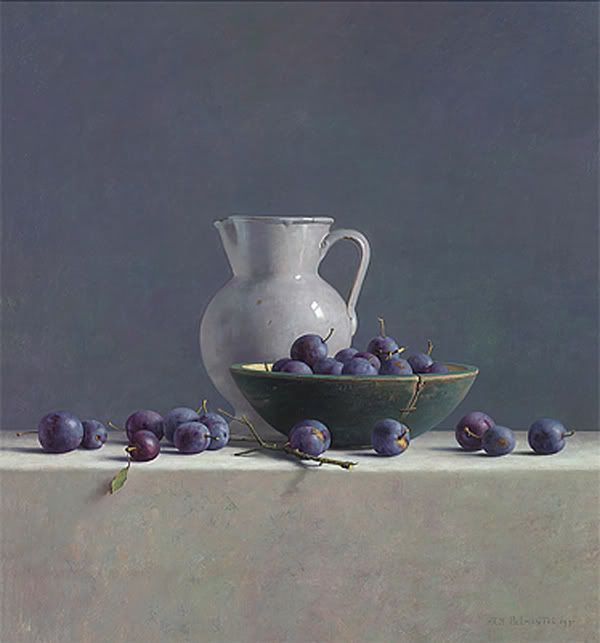
What struck me wandering around, was how tranquil, focussed, and simple most of the pictures were. They were mostly fairly large in format. As a viewer, I had the feeling that the artist was consciously showing these objects to me, rather than permitting an intimate view of something otherwise quite private. These works were, therefore, less intimate than their much earlier Dutch predecessors. But the choice of objects depicted was very similar. They were all simple household items, bits of fruit and vegetables, mostly locally grown like asparagus or chestnuts. There were simple boxes, bowls, and glass vases, some antique, but displayed in a consciously chosen space, in a balanced and symmetrical way, and whose clear and clean lines reminded me of Danish art that emerged around the beginning of the 19th century.

IMG_7185

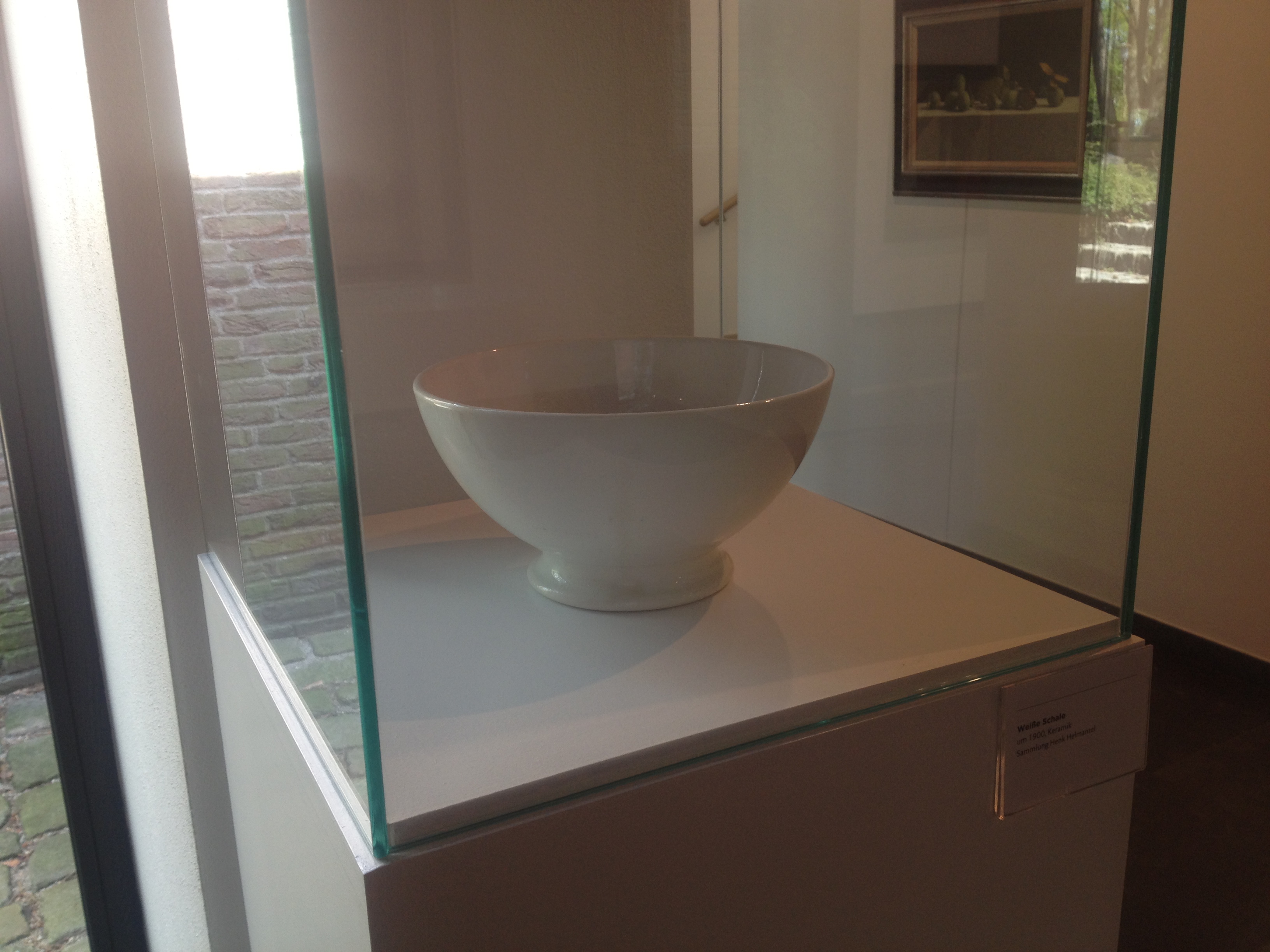
Many items depicted stemmed from the artist’s collection. But there was no highly precious or prestigious aura surrounding them. There were no exotic features or valuable items. Their value was based upon, so it seemed, on shape and colour, or their proportions. A bowl on a narrow rim, with an even cream glaze, which Helmantel had painted holding nine eggs (see above) was displayed in a glass showcase that accentuated its simplicity and serenity.

IMG_7187

The Artist Henk Helmantel

Born in 1945 in Westeremden in Holland, which lies North of Groningen, Helmantel was raised as one of five children. His parents owned a nursery and the children helped sell their plants and flowers at the traditional local markets, like in Groningen. The story goes that on one of these trips Helmantel made his very first visits to a museum and was overly impressed by Rembrandt. From then on he collected any snippets and pictures from newspapers and magazines he could find. He was determined to become a painter, later attending the art academy in Groningen.

It became obvious to me that he was a diligent and meticulous worker, dedicated to depicting these serene objects in the most naturalistic way possible. He was obviously interested in the unique surfaces of the objects, like in the irregular iridescent glass of his collection of Roman vessels (see picture above). But at the same time, he wasn’t taking any liberties by letting a single brush stroke stand out or have an expressionistic or impressionistic character, let alone by being textural. Each stroke serves the depiction of the object in the most naturalistic and realistic way possible.


Still Lifes and the Art of Tranquility

Personally, I love texture and abstraction in painting. I only recently saw a quite impressive exhibition of William Turner‘s work at the Getty Museum in Los Angeles. But that afternoon, it was the clarity and focus in Helmantel’s paintings that inspired me. Even his more involved paintings are evenly and thoughtfully grouped objects. There are no coincidences. Everything is consciously arranged, which also means that each object is taken seriously within its own unique value. I told myself:

Take every piece, each poem you write, every song you sing seriously, take it for what it is!

I could feel the jumble in my head and the doubtfulness that tortures every artist more or less frequently being soothed. I kept thinking,

Stick to what you do, and do it with dedication, clarity, and consciousness! Or like the French author and philosopher Albert Camus said:
“Find meaning. Distinguish melancholy from sadness. Go out for a walk. It doesn’t have to be a romantic walk in the park, spring at its most spectacular moment, flowers and smells and outstanding poetical imagery smoothly transferring you into another world. It doesn’t have to be a walk during which you’ll have multiple life epiphanies and discover meanings no other brain ever managed to encounter. Do not be afraid of spending quality time by yourself. Find meaning or don’t find meaning but ‘steal’ some time and give it freely and exclusively to your own self. Opt for privacy and solitude. That doesn’t make you antisocial or cause you to reject the rest of the world. But you need to breathe. And you need to be.”
— Albert Camus (Notebooks 1951-1959)


Simplify and focus!


Henk Helmantel

IMG_7198

IMG_7191
All paintings above by Helmantel

IMG_7188

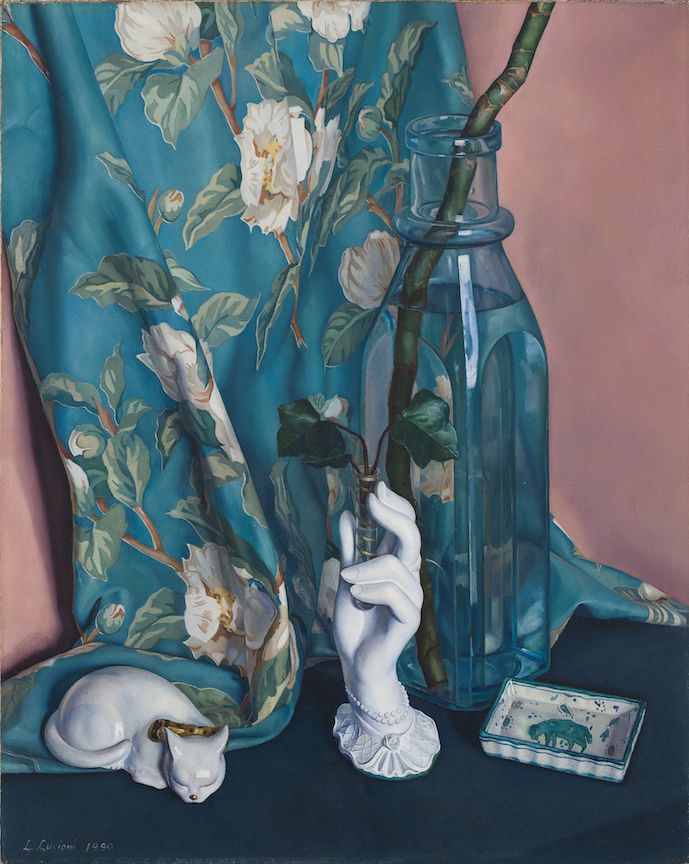
Luigi Lucioni, Arrangement in Blue and White, 1940. DC Moore Gallery, New York NY USA


(c) Frances Livings, 2015


Here’s a playlist for a more uplifting mood:

Did you like this post? If so, why not…

Eating the darkness songwriting inspiration Francesca Woodman Wallpaper empty room abandoned building naked floorboards self-portrait

Eating the Darkness. Francesca Woodman’s Wallpaper


Listen to parts of the blog post here:


I was browsing through The New York Times when one article really grabbed my attention. It was on the American photographer, Francesca Woodman, whose work I had only recently discovered. Her oeuvre consists mainly of quite unusual self-portraits and one of her pictures, titled Vanishing Act had inspired me a while ago. It had actually helped me complete my song, Eating the Darkness that I recorded for my first solo album. I learned that over 120 of her works were being displayed at the prestigious Guggenheim in New York, which felt really exciting – because, in a way, it was actually quite personal.

I love art photography and can easily lose myself scouring the Internet, searching for interesting pictures and inspiration. That particular day I was compiling a collection of photos, mainly by female artists. A lot of them were in black and white, many with a surrealistic approach, and somewhat dramatic and staged effects. I didn’t have any specific motifs or topics in mind but just followed my instincts and mood. I downloaded quite a few pictures, whose meaning especially struck or touched me on a very visceral level.


Collecting Inspiration From Other Artists

It was the contemporary visual artist Christian Marclay who stated, in the context of creating his video collage The Clock:

If you make something good and interesting and [are] not ridiculing someone or being offensive, the creators of the original material will like it.

Not only is Marclay a collector of images himself, but for his acclaimed installation, which is 24-hours long, he collected thousands of film and television images of clocks film clips depicting time. He created a montage of, edited together so they show the actual time.

Eating the darkness songwriting inspiration Francesca Woodman Wallpaper empty room self-portrait
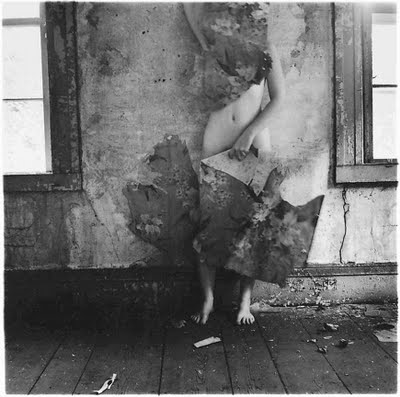
© Francesca Woodman, Vanishing Act (Space2) 1976

These collections of images often trigger my own creativity by directing me towards a topic – a topic that has most likely already been slumbering in my sub-conscience. Images act for me like teasers or “dream catchers” or even as surfaces for my own emotional projections. Traditionally, this is actually known as Ekphrasis, which means “description” in Greek. An ekphrastic poem, for instance, is a vivid description of a scene or, more commonly, a work of art – whereby the poet may amplify and expand its meaning. It is used to convey the deeper symbolism of the corporeal art form by means of a separate medium.


Conveying Feelings in Song Lyrics

In this particular situation, images, thoughts, and feelings must have all run together: I was both deeply touched and inspired by that photograph of Woodman. It not only helped me to get unstuck emotionally but ended up delivering a line for my song, Eating the Darkness.

I had been playing around on the piano – which is what my usual songwriting process looks like – and working on the song Eating the Darkness (click on the title to read the lyrics). I wanted to capture feelings of loneliness and despair, staged in the isolation of an apartment or a room. These are the first verses of the song:


I turn the key and stare into a
long, dark corridor
I see the furniture – untouched and cold,
the emptiness starts to unfold.

Dust has settled with no delay
upon my absence, during the day
while everything’s / just frozen in its place
from when I left at twenty past eight

Like with a lot of my songs I went through a strange process: There is an initial spark, the idea or inspiration but still a lot of work to be done. Some songs practically write themselves but with others its like being in labour with pains and horrible cramps burgeoning into anxiety. But when you finally summon up that energy and determination to push, you give birth to something that almost immediately takes on a magical life of its own. If you can’t activate that courage to face all of those feelings, the idea dies.


How to Express Feeling Invisible?

I just felt that in the chorus there was still a strong image missing, which is why I kept getting stuck. Even playing the melody over and over again wasn’t helping. I felt that the song per se was strong and authentic. It had emerged very out of the depth of my guts like from a deep-sea cavern. But I wanted to explore and express a feeling of hopelessness, set in the isolation of a room. How could I convey that gnawing and devastating emotion of not feeling relevant, of feeling invisible? Suddenly this photograph entered my mind. It just presented itself. So I opened up my laptop and fished it out of my pictures folder.

The photograph, Vanishing Act from 1976, partially shows the torso of a nude standing on broken, wooden floorboards, in front of the wall of an obviously derelict building. The anonymous, faceless woman is half-covering her body with large sections of the peeling wallpaper – with which she seems to be almost merging. 

“Fading into the wallpaper”, I thought. And suddenly the chorus was complete:


And I sit here eating the darkness
and the darkness eats at me
I am fading into the wallpaper
on the second floor apartment number two-o-three


Who Is Francesca Woodman?

Prior to finding that photograph I hadn’t heard of the artist Francesca Woodman before. Of course, her name, derived from the same source as mine, caught my attention. But it was after having completed the song lyrics that I suddenly wondered, where and in which stage of her life would I find her? I set out to contact her. Not only did I want to thank her for the inspiration but I also wanted to share my work once the song was recorded…

It only took a few seconds on Google and I was staring at the ugly word – suicide.

Unexpectedly, I just hit the wall. No pun intended.

Suicide is usually the result of deep and dark depression, of being in a place of utter hopelessness. Maybe my highly sensitive side, also my dark side had intuitively picked up on the tragedy of her death through that very picture. Was that why ultimately, my writing had become fluent again? At the same time, questions started rolling in…

Had she perhaps felt that she had exhausted her artistic reservoir with nothing left to say? Had she lived “too fast”? Was she able to channel these feelings so well, because she also suffered in such an intense way? Was this why the photograph had had such a deep impact on me?

But did I really want to speculate about her reason to end her life?

No. I decided to distance myself. I suddenly felt eerily close, almost intrusive upon her life, like a voyeur. So I refocused on my song and recorded it.


Images Full of Self-expression, Texture, and Sense of Composition

I didn’t go back to look at more of Woodman’s work until weeks later. A lot of it I still hadn’t seen and I was still very curious about it. What I really appreciate about her photographs is her self-expression, the use of textural elements, and her sense of composition. Her open and almost Victorian sense of Romanticism may be “girlish” as some critics say, but it is also very self-exposing. Some of the pictures are in a square vintage style format, reminding me of Instagram. I find many of Woodman’s pictures playful as well as incredibly mature. To think that, at 22, she left an extensive catalogue of over 800 photographs behind is admirable.

For decades, photography was still thought to fall below painting in the hierarchy of mediums in art. It wasn’t accepted as fine art until the 1940s in the United States and the 1960s worldwide. But especially for women artists, it was an important medium because it granted a mode that was relatively free from the heavy, male-dominated history of the painted canvas.

There’s an anecdote that Woodman was asked by a friend, why she obsessively photographed herself. Her friend may have found it oddly narcissistic and simply still unusual. Because we mustn’t forget that Woodman created all of these self-portraits in the mid and late seventies – so long before the selfie developed as a medium of self-reflection and self-representation. Woodman replied, simply saying:
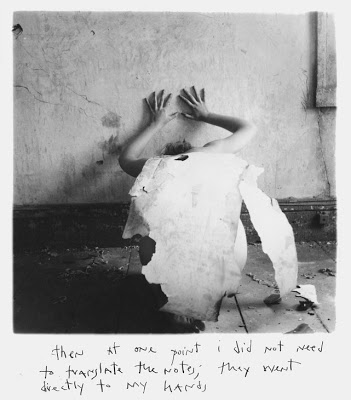
I am always available.

Woodman exclusively used herself as a model, which made me think of other female photographers, especially of another American photographer and filmmaker: Cindy Sherman. Sherman’s work consists primarily of photographic self-portraits, in many different settings, with wigs, make-up, and props to create various imagined female characters. Another famous self-portraitist is Vivian Maier, considered the queen of street photography, who created many iconic pictures of her reflection in shop windows. There are many more of course, like Diane Arbus (1923 – 1971) who focused on an exceptionally singular demographic – the marginalized. She captured the images of dwarfs, giants, transgender people, nudists, circus performers, and many other surreal personas that captured her attention. She is often considered the Sylvia Plath (1932–1963) of photography because of her work as well as her early suicide.


© Diane Arbus, Untitled 1970-71
© Vivian Maier, Self-Portrait, 1954
© Vivian Maier, Untitled, undated

The British art historian, Frances Borzello, who specializes in the social history of art, wrote a book on female self-portraits and female nudes. It is titled Seeing Ourselves: Women’s Self Portraits. I found it most relevant, that she notes: The singular importance of this particular genre, the self-portrait is for women a “way to present a story about herself for public consumption,” a rare break from the typical objectification of the female form as depicted by the male artist.


Eating the darkness songwriting inspiration Francesca Woodman peeling wallpaper fireplace empty room abandoned house self-portrait
© Francesca Woodman, House #4 1976
Eating the darkness songwriting inspiration Francesca Woodman polka dot dress peeling wallpaper floorboards empty room abandoned house self-portrait
© Francesca Woodman, Polka Dots 1976
Eating the darkness songwriting inspiration Francesca Woodman body print black shoes woman floorboards empty room abandoned house self-portrait
© Francesca Woodman, Untitled 1976

Eating the Darkness. Desolate & Abandoned Interiors

What strikes me most is the textural quality of the settings, in which Woodman stages her photographs. Frequently, the interiors are empty, decaying rooms, with peeling wallpaper, cracked plaster, broken floorboards, and flaking paintwork. In their roughness, they are diametrically opposed to the smoothness of her young and flawless body. On the other hand, in many of her photographs, she seems to merge with her environment, which gives them a haunting quality.

The photographer, Victoria O’Rourke had similar thoughts about Woodman’s integration and depiction of wallpaper:


The wallpaper also puts the identity of Woodman in a state of flux in two ways – by physically hiding her and by forcing into your mind the very literal and paradigmatic image of a second skin. It joins neatly with the idea of a shifting identity, rather than Woodman presenting herself as a whole. She transforms before us, not into another human being or character, but simply into the wall. ~ Victoria O’Rourke, photographer


Eating the darkness songwriting inspiration Francesca Woodman peeling wallpaper floorboards empty room abandoned house woman self-portrait
© Francesca Woodman, 1976

These rooms look desolate and possess a strong notion of abandonment. They are very similar to the atmosphere of space I wanted to create in my song without using lengthy descriptions.


Wandering rooms like in quarantine

I’m starring at the clock, on elasticated time

brain waves flickering, mercury mind

like a black’n white TV in 1969


Losing my mind, losing my mind…

“Losing my mind…” maybe we are all afraid of that sometimes. It can feel infectious – is why I had distanced myself from the artist after the initial encounter? I had peeped in but knew I had to protect myself and very quickly slam the book shut again. After learning about her suicide, it was painful to see her pale and vulnerable body in contrast with the diminishing interior. Moreover, it was a fearless easiness and eagerness; revealing a form of self-exploration, that stood out against the derelict environment.

But another sensation that arose much later was gratitude. Suddenly, I felt fortunate that I had connected with this picture – and ultimately, with another creative force through my own art. The connection wasn’t formed through a biographical prism – or even the dramatic notion of an artist’s suicide. Because it can sometimes be difficult to push past layers of fragmented knowledge and prejudice, a sense of sensationalism even… especially in an era of information overload, or fake news, and constant accessibility per Dr. Google.


Only when “absorbing” art in an almost meditative state, is it possible to retrieve what lies beneath these layers and connect with our own authentic thoughts and feelings. – Frances Livings

This is exactly what I feel she did in her work. She tried to expose herself and be literally, as naked as possible. We will never know whether this specific image, the wallpaper was created to express a loss of self-worth. That may have been what I personally projected onto it. I am grateful that a fellow artist gave me something to connect with, almost like a piece of her soul. Because isn’t that what every person who creates seeks to achieve? We want to touch or inspire someone and almost live on through our work. Francesca Woodman definitely hasn’t faded into the wallpaper. And I am fighting not to either…


Thank you for reading!

You are welcome to share any thoughts in the comment box below.

– Frances Livings


Buy your copy of Eating The Darkness here:


If you found joy or inspiration in this post  


Watch The Documentary The Woodmans here:

Livings in Los Angeles – Ant Man, Teddy and Rabbit. Thoughts on the Artist Mike Kelley

One afternoon, on one of my frequent outings to the Galerie der Gegenwart (gallery of contemporary art) in Hamburg, I found myself transfixed by eight very unusual portrait photographs. Individually depicted were seven cuddly toys. Their stitched-on fabric or glass button eyes, some loose and lopsided, seemed to be starring at me, wanting urgently to capture my attention. One photograph however, was of a stern looking younger man who I assumed, was of the artist himself. The portraits were all displayed in a very simple frame and hung as a group in two rows of four. They looked like mug shots.

That was in the mid nineties when I was a junior student of art history and first discovered the work of the contemporary American artist Mike Kelley and immediately, it clicked. I didn’t know anything about his background, but again and again I couldn’t help thinking about these colour photographs, which soon found their way into music culture when Kelley created the artwork for Sonic Youth’s 1992 album Dirty, using Ant Man’s “portrait” on the album cover. In addition to being a renowned visual artist, Kelley was also a musician. He was a founding member of the proto-punk Detroit band Destroy All Monsters, who earned a cult following with their experimental performance art. By the 1990’s his art career was blooming.

Mike Kelley, “Ahh…Youth!” 1991, set of 8 Cibachrome photographs, 24 x 20 in. each; one at 24 x 18 in. Mike Kelley Foundation for the Arts.

On a cursory glance, the ensemble looked like an advertising campaign for an innocent and happy childhood. But it conjured up a completely different meaning: The features of its relicts, the stuffed animals, were stiff and unhappy looking. These were tatty creatures with dirty, worn and clumped fur, limp limbs and a blank stare. They were after all, visual tokens of having been thrown, kicked, punched, spat, cried and vomited upon. In the presence of a male adult however, they seemed to stand for a collective memory of child abuse and therefore seemed to almost immediately epitomize trauma. Were Ant Man, Teddy and Rabbit physical witnesses to something horrible that was inflicted upon them? Or did they stand – their images physically enclosed and kept in tyrannical order by a strict, linear picture frame – for something that was kept secret within the walls of a children’s nursery?

On the other hand, these individual portraits were like a collection of mug shots depicting cuddly toys more like perpetrators on the stand. From that perspective they seemed to suddenly stand for shame and guilt but how could stuffed animals be guilty of anything? But that’s exactly what was triggering and made the artwork so memorable. In society nurseries are considered to be safe, childhoods happy and parents loving – which is why ultimately, abuse is so crazy making. This is also why there are still so many moral conflicts with challenging these ideas; any notion that would disrupt these stereotypes and clichés are easier being denied, which is why at that point in my life, just intuitively, I found his work compelling and courageous.

*

My second very intense encounter with the artist wasn’t until I was living in Los Angeles almost two decades later. On a fairly uneventful day, cup of coffee in hand, I was flicking through the L.A. Times when I read that he had committed suicide. I was shocked. He was only 57 and had by then established himself as an artist internationally. Online I read in further articles that only around four hours after confirmation of his death, an unofficial, makeshift memorial had started to appear in an abandoned carport, a few blocks from Kelley’s home in the Farley Building in Highland Park. Built from stuffed toys, wax candles, Afghans and dried corn, mourners began replicating his assemblage More Love Hours and Wages of Sin, two paired installations Kelley had exhibited in the Whitney’s 1989 Biennial. I also learned that The Mike Kelley Foundation was organizing a memorial that was to be held at his studio in Eagle Rock/Highland Park.

I felt he deserved my tribute too. He had shown courage touching upon subjects that are still – thirty years later – socially somewhat taboo. As a child you mostly have no alley when being abused or mistreated, ignored, neglected by a parent. He epitomized these complicated and highly problematic emotions.

So on one of these for Los Angeles typical, far too mild February evenings, my husband drove through dimly lit streets to Kelley’s former residence. We parked on a side street lined with old gnarly oak trees, spiked with well-kept 19th century craftsman bungalows, typical for South Pasadena. Like many areas of Los Angeles, it felt very insular, especially because of the isolating pockets of dim lighting. I walked up to the main road towards the building in which the memorial was taking place. Its concrete steps led up to a very somber looking entrance where a handful of people stood, collectively nodding as if to acknowledge our arrival. I felt a slight wave of guilt wash over me for being curious in a weirdly voyeuristic way. I had never met this man and yet I was showing up at a memorial – like a grief tourist?

Approximate another 100 people and I wandered around aimlessly through this vast space, which had been, only days prior to his death, his studio. Plastic cup in hand, filled with cheap red wine, I explored a maze of small administrative looking side-rooms, watching sometimes only for minutes films that Kelley had created. The main space, his studio, where more art installations were displayed and further screenings took place, reminded me of a large airplane hangar.

I was not really interested in speculating about why precisely he killed himself. From the press I later learned that he suffered from depression – quelle surprise. Looking at his body of work, one may interpret his works of art, like described above, as a result of trauma, translated into the many quite disturbing images he produced. But I wasn’t interested in asking whether this ensemble of abused looking creatures gave the observer biographical information.

Probably like a lot of other people, I asked myself, why would he end his own life? Unlike many artists he was successful and popular. Being a struggling artist myself, it actually made me a bit angry. How dare he? How selfish. I suddenly felt very strongly that every artist, whether writer, painter or musician carries a responsibility towards their creations, to ensure the future delivery of such. Without them their art will not be created and the commercial art world takes over. How can therefore someone give up on him- or herself without giving up on their art? Suicide is the conscious choice to depart from one’s life. Most artists are controlling. They have to be. I know from my own work that once I envision something and have a precise idea of what and how I want to create something, I am very adamant about its execution. I will explore, search, uncover, unravel, shuffle and experiment but once I get close to what I was meant to create I don’t dither or question. Interwoven with this notion is the question, where does art end and where does the artist start?